
by Dr. Elisabeth Lukas
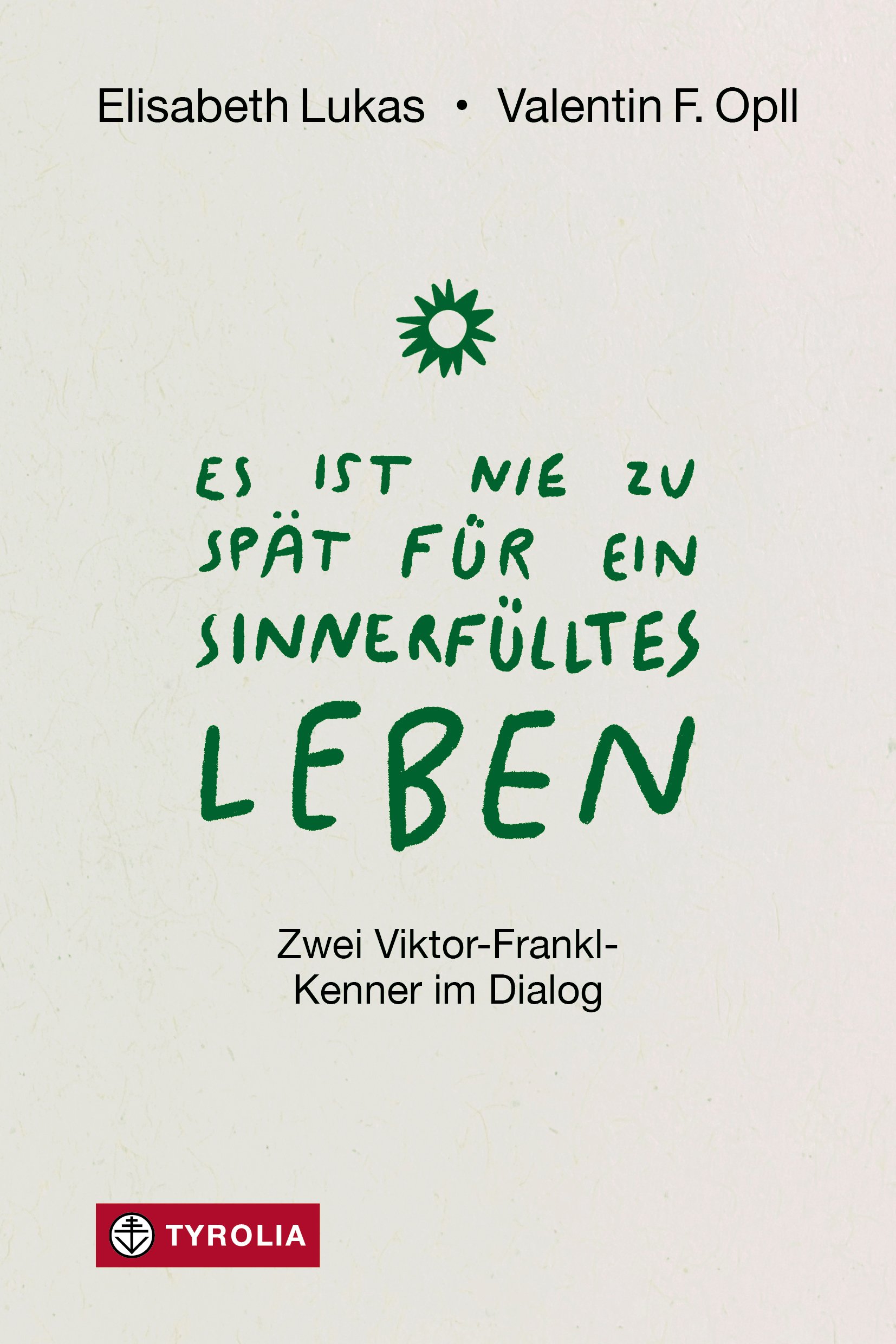
ISBN: 978-3702243258
Pub Date: February 7 2025
Imprint: Tyrolia
In 1926 Viktor Frankl gave a speech to the Academic Society for Medical Psychology in which is the first documented use of the term “logotherapy.” One hundred years later, logotherapy is a full-blown school of psychology with practitioners and institutes worldwide. Now, one hundred years later, one of Frankl’s most highly valued successors, Dr. Elisabeth Lukas, sits down to engage a new generation of Logotherapists via a dialogue on the topic found in this book’s title: It's Never Too Late for a Meaningful Life: Two Viktor Frankl Experts in Dialogue How We Can Overcome Crises and Find New Meaning in Life.
Elisabeth Lukas is well-known as one of the most prolific writers and promoters of Viktor Frankl’s Logotherapy. Her conversation partner is Dr. Valentin Ferdinand Opll, educator and psychotherapist at the Anton Proksch Institute in Vienna and also in private practice. His areas of expertise are addiction therapy and family counseling. Together these two represent more than just two different generations, but other differences in terms of training, praxis, and outlook, all within the realm of logotherapy and existential analysis. In other words, Drs. Lukas and Opll are as similar and different as any two Logotherapists on this planet. But to be clear, Lukas, by her orientation, history, and oeuvre might be described as “orthodox” whereas Opll practices logotherapy along with other methods. This comes out in the discussion.
Aside from a brief introduction titled, “Does my life still have meaning?” written by Lukas, this is truly a dialogue captured and recorded for posterity. It may be structured like a book and divided into chapters, but it always retains the feel of a single, ongoing conversation, though no doubt it has been edited for readability.
As may be expected, the introduction, sets the tone for the conversation. In it Lukas presents nine brief examples of difficult circumstances people may face in life, including natural disasters, a child’s suicide, abuse, the inability to have children, etc. Each of these scenarios beg the question, “Does my life still have meaning?” This is followed with a brief biographical sketch of Viktor Frankl’s tragic circumstances, his philosophy of life, and his many subsequent accomplishments. Then she applies Frankl’s logotherapeutic approach to each of the nine scenarios as a way of finding meaning in each set of difficult circumstance and ends the introduction with a word to the reader about the value of logotherapy’s worldview for every person’s life.
The chapter headings which give structure to the flow of the conversation are as follow:
Which paths lead to meaning?
What really makes us strong
The problem with trying to make things better.
What gratitude can do.
What development makes possible.
Frustration, aggression, and manipulation.
Viktor Frankl – the “thinker to the end.”
Obstacles and Aids.
Was it a wasted effort?
Self-image and authenticity.
Standing up to fear and compulsion.
The miracle of becoming human.
Accepting help can be difficult.
Suffering makes people clairvoyant.
A trained Logotherapist can get a feel for the topics discussed simply by looking at these chapter headings. But the value of this book is not in presenting anything new, but rather the opportunity it gives the reader to listen in on a conversation between two practitioners, comparing notes on treating clients experiencing many of the struggles and vicissitudes of life. We, the readers, get to witness the well-seasoned wisdom of Lukas from her many years of practicing logotherapy and her close friendship with Viktor Frankl, as she imparts wisdom to her younger colleague, Opll.
Earlier I described Lukas as more “orthodox” in her practice of logotherapy. By this I refer to the primacy Viktor Frankl’s thought holds in her practice of logotherapy. This is not to say that Lukas is unfamiliar with or disapproving of other methods. Her knowledge of other schools of thought and their usefulness is clear from the discussion, but it is also clear that her practice is firmly rooted in Logotherapy and Existential Analysis. Opll, who specializes in addiction therapy and family counseling, practices logotherapy in conjunction with other methods, particularly depth psychology, which he raises from time to time.
One of the unexpected pleasures of this book comes in the section titled, “Transgenerational trauma and resilience” where Lukas describes the difficult circumstances of her early life. She was born in 1942 and lived through the bombing of Vienna as an infant. Because her grandparent’s home had been destroyed, she grew up in a two-room apartment with all five people sleeping in one room until graduating from high school. Rather than look at the deficits of that situation, Lukas talks about the advantages of knowing her grandparents and of having a close family. And this, of course, illustrates the importance for Lukas of not dwelling so much on past trauma as on the meaning of life.
Whether by coincidence or on purpose, this dialogue on the value of Logotherapy and Existential Analysis comes just in time to mark the centennial of the term “logotherapy.” Lukas represents the faithful continuance of Viktor Frankl’s work into the 21 st century, and Opll represents the gradual passing of the torch to another generation of Logotherapists. It is our benefit to be able to listen in on their conversation and gain insight into our own work.
Tom Edmondson for meaninginministry.com
Date Of Review: February 2026