
Broken Lineage: Viktor Frankl, Alfried Längle, and the Division of Logotherapy and Existential Analysis.
by Alexander Batthyány
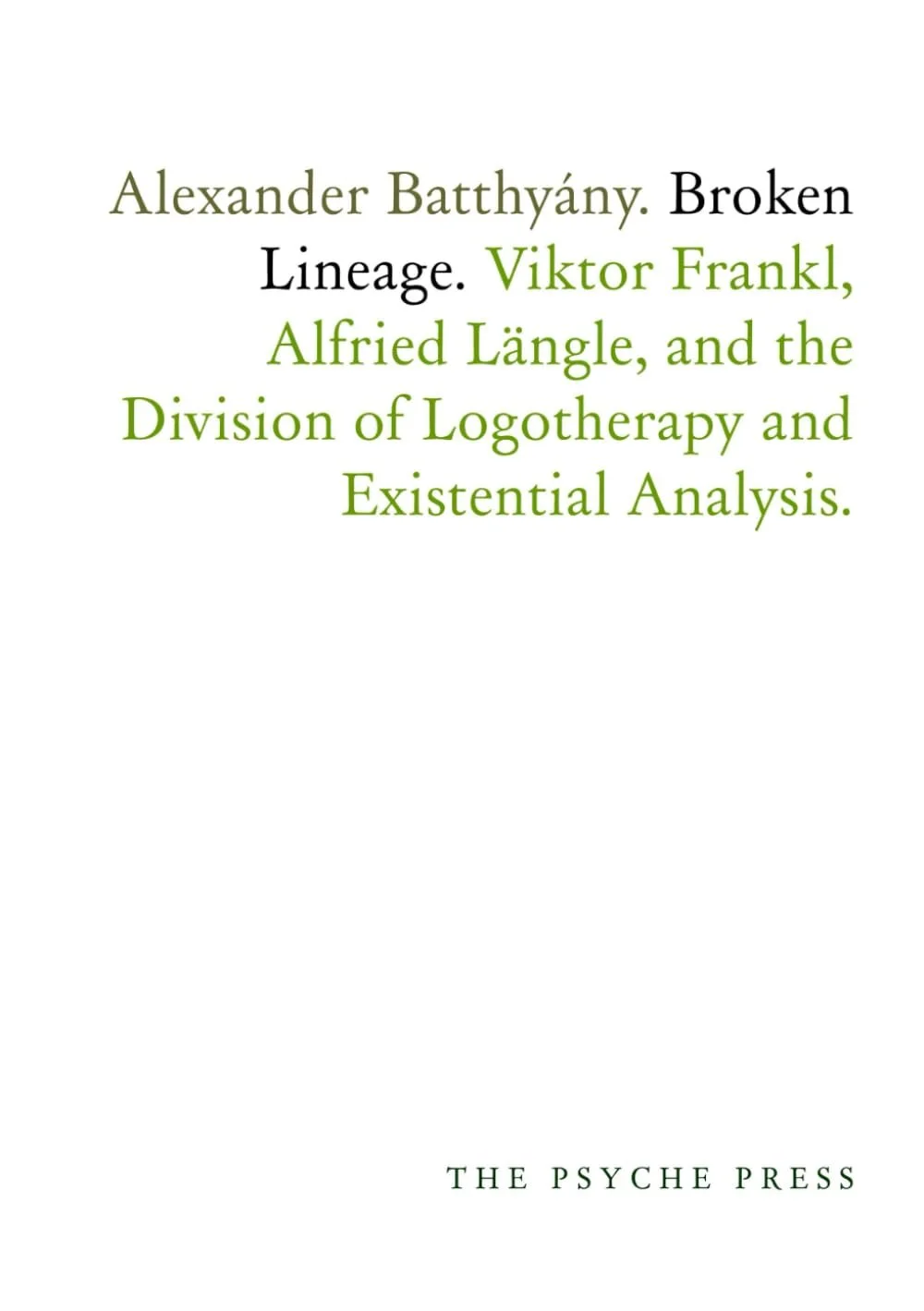
ISBN: 978-3200107779
Pub Date: September 23 2025
Imprint: The Psyche Press
Anyone searching online for information on Logotherapy and Existential Analysis (LTEA), either for training or for therapy, will find a remarkable number of institutes worldwide, but especially in Europe. When I began the search for training in LTEA, I noticed that some of these institutes are recognized by the Viktor Frankl Institut in Vienna, but not all of them. And interestingly, I found one institute in Vienna separate from and not authorized by the Viktor Frankl Institut: the GLE, or the “Gesellschaft für Logotherapie und Existenzanalyse – Wien (GLE-International)” founded by Alfried Längle. How odd.
That Längle was once a student of Viktor Frankl and continues to claim inspiration from him, stood in stark contrast to the fact that the GLE was not listed as an authorized (or recognized) institute. This fact steered me away from exploring that option further. Later, after completing my own training from two of the authorized institutes, I feel better equipped to understand the philosophical rift between Frankl and Längle and am comfortable in siding with Frankl.
Now, thanks to Prof. Alexander Batthyány, a history of this important break is available in a very readable and thorough account. Though we know which side Batthyány favors, he maintains an academically polite and balanced discussion of the history of the split beginning in 1991 with Frankl’s resignation as honorary president of the GLE. Batthyány allows Frankl and Längle to speak for themselves through their own statements from print sources and private archives and occasionally brings in other voices. As far as I am concerned, no matter how followers of Längle react to this book, Batthyány’s presentation demonstrates a very deep dive into the GLE’s—and particularly Längle’s—writings and resource materials. I don’t think anyone could accuse him of stacking the deck in Frankl’s favor. And as he states in his brief closing chapter: “I welcome responses, critiques, and further reflections from all quarters.” It will be interesting to see if and how anyone responds from the GLE.
And this is kind of the problem. Many Logotherapists trained in institutes authorized by the Viktor Frankl Institut in Vienna, have little to no knowledge of Längle or the GLE. For the most part, I would say that we have simply ignored this other group despite our common terminology and claim to Frankl’s legacy. This fact makes this book highly recommended if not required reading.
Rather than reveal or regurgitate the contents of this excellent book, I will end by briefly describing the chapters. Hopefully the reader will find it as rewarding as I did. Chapter 1, “Mapping the Territory,” does just that. It lays out issues and clearly delineates their development in each school of thought. The conclusion is that they are fundamentally different systems. Chapter 2, “Logotherapy and Existential Analysis” is both a history of Frankl’s thought from the early days as well as its unique place in psychology and its key feature: an anthropology of humanity that includes a higher noetic dimension. And thus, it is Frankl’s anthropology where the two schools differ the most. (Chapter 2 is the highlight of the book for me). This is further spelled out in chapter 3, “Fault Lines,” which also raises another insightful question: If the disagreement was so strong, why does Längle and the GLE claim Frankl and Logotherapy and Existential Analysis? Why not rename his school of thought as Adler and Jung did when leaving Freud and Frankl did when leaving Adler?
In chapter 4, “Practice,” Batthyány demonstrates the key differences in how Längle’s practice of Logotherapy differs from that of Frankl. The reader can judge for his or her on self based on the presentation—which is balanced in my view—and can even dig deeper. I think Batthyány was very polite in his presentation of Längle’s practice, and I will be too. But this brings us to chapter 5, “Taking Stock.” And as I already mentioned, this short chapter is where Batthyány offers a kind of olive branch while welcoming serious dialogue. What else can I say but get this book and read it.
Tom Edmondson for meaninginministry.com
Date Of Review: December 2025