
Pastoral Logotherapy and the Care of Souls
Rev. Tom Edmondson
24th Logotherapy World Congress
Panel: Religion, Spirituality, and Transcendence
As a local church pastor who integrates Logotherapy and Existential Analysis into pastoral care, I have a special appreciation of Man’s Search for Ultimate Meaning (2000). The thesis statement for this book is found in the Preface to the First English Edition and is stated as follows: “There is … a religious sense deeply rooted in each and every man’s unconscious depths” (Frankl, 2000, p. 14). This thesis is unpacked and developed throughout the book in Frankl’s discussion of the spiritual unconscious, intuition, artistic creativity, dreams, and the conscience. While we may briefly define Logotherapy as “therapy through meaning,” Frankl was also clear that Logotherapy and Existential Analysis is a spiritual therapy. Not spiritual in a religious sense, but as in recognizing the human spirit as the dimension of human nature that searches for meaning.
Generally, Frankl’s writings leave revealed theology and religion to pastors, priests, and rabbis, but in this particular book he addressed religion, spirituality, and transcendence via the conscience, dreams, creativity, and ultimate meaning in relation to the human noëtic realm. These discussions include examples of people who experienced neurotic or psychotic disturbances but still had access—though sometimes severely limited—to their noëtic core. It was this connection to the transcendent via their noëtic cores that, despite their physical or psychological limitations, allowed them to express creative, experiential, and attitudinal values, cope with their disorders, or achieve a certain level of healing.
Returning to the thesis statement in the preface, Frankl added a corollary statement that this inner religious sense “may break through unexpectedly, even in cases of severe mental illness such as psychoses” (Frankl, 2000, pp. 14-15). This point is repeated in Frankl’s 1985 Oskar Pfister Award Lecture also titled, “Man’s Search for Ultimate Meaning,” and is included in this same volume. It addresses religion from an existential point-of-view. Rather than making truth claims for one religion or another, Frankl asserted that human religious behavior is more than just an existential response to life, but also stands as phenomenological proof of the existence of an inner religious sense:
In a book of mine, The Will to Meaning, I describe the case of a severe manic phase (Frankl, 1984b), in other books of mine a patient suffering from an endogenous depression (Frankl, 1985a) and other patients suffering from schizophrenia (Frankl, 1984a, b)—all of them showed an indestructible and indelible sense of religiousness [emphasis added]” (Frankl, 2000, p. 153).
Thus, we can see that from beginning to end, in the English edition of Man’s Search for Ultimate Meaning and its supplementary materials, Frankl’s presentation of evidence for the existence of an “inner religious sense” is reinforced with examples that include neurotic and psychotic issues.
In this paper, I present six statements culled from the following books and essays: Man’s Search for Ultimate Meaning (2000), On the Theory and Therapy of Mental Disorders (2004), The Will to Meaning (1988), and the essay, “Psychotherapy, Art, and Religion,” found in Psychotherapy and Existentialism: Selected Papers on Logotherapy (Frankl and Crumbaugh, 1967). These six theses express Frankl’s conviction that, though hindered by illness of the mind or body, there is an uninjured human spirit. And in each of these six examples particularly, religion or spirituality was the bridge either to noëtic healing or the adoption of attitudinal values in unalterable situations.
We have already read the first thesis from Man’s Search for Ultimate Meaning, but here is the longer version which includes the corollary statement: “There is … a religious sense deeply rooted in each and every man’s unconscious depths … this sense may break through unexpectedly, even in cases of severe mental illness such as psychoses” (Frankl, 2000, pp. 14-15). The inclusion of the phrase, “may break through unexpectedly, even in cases of severe mental illness such as psychoses” reminds us that it is often the experience of neurosis or psychosis that brings a person to an awareness of unconscious—or repressed—spirituality. The fact that it breaks through—even unexpectedly—serves as phenomenological proof of this inner religious sense grounded in the human spirit.
Thesis one, then, speaks to the fact that behind the psychosis or neurosis, there is an “uninjured” human spirit to be uncovered and activated in the healing process. This is the stated purpose for the practice of Existential Analysis, as Frankl wrote in On the Theory and Therapy of Mental Disorders: “Existential analysis awakens … a humanity that is uninjured and is incapable of being injured. Existential analysis tries to teach us how to make this visible even through the veil of neurotic derangement and psychotic madness [emphasis added]” (Frankl, 2004, p. 60).
Each thesis in the discussion that follows, adds a nuance to this exploration of accessing the human spirit when working with people experiencing a neurosis or psychosis. Thesis 2 comes from Frankl’s essay, “Psychotherapy, Art, and Religion” (Frankl, 1967, pp. 165-181). This example is actually a fuller account of an artist’s spiritual crisis that is briefly described in Man’s Search for Ultimate Meaning, pp. 50-55. In this longer but earlier version, we learn that the patient’s presenting issue was neurotic behavior and artistic frustration—she couldn’t paint. It was only during the course of treatment that the real issue emerged. As Frankl wrote: “the patient was struggling for two things: her work and God … The religious problem was not apparent in the beginning of the treatment but spontaneously broke through in its own course [emphasis added]” (Frankl, 1967, pp. 165-166). Thesis 2 follows: “Psychotherapy, handled correctly, will release a patient’s religiosity [emphasis added], even if that religiosity was dormant and its release was not at all intended by the therapist” (Frankl, 1967, p. 166). Because Frankl believed the inner religious sense is a human characteristic—a strength rather than a crutch—he was able to recognize it as such and assist the artist in her search for meaning/healing along spiritual lines. But we could imagine a very different outcome for her if she had been treated by someone from a different school of thought whose weltanschauung considered the religious sense as the neurosis rather than its cause and its cure.
Theses 3 – 6 are drawn from the chapter, “Medical Ministry” in The Will to Meaning: Foundations and Applications of Logotherapy (Frankl, 1988, pp. 131-141). Frankl’s discussion of Joan of Arc in this chapter serves as an excellent setup for these four theses:
There is no doubt that from the psychiatric point of view, the saint would have had to be diagnosed as a case of schizophrenia; and as long as we confine ourselves to the psychiatric frame of reference, Joan of Arc is “nothing but” a schizophrenic. What she is beyond a schizophrenic is not perceptible within the psychiatric dimension. As soon as we follow her into the noological dimension and observe her theological and historical importance, it turns out that Joan of Arc is more than a schizophrenic. The fact of her being a schizophrenic in the dimension of psychiatry does not in the least detract from her significance in other dimensions. And vice versa. Even if we took it for granted that she was a saint, this would not change the fact she was also a schizophrenic (Frankl, 1988, p. 29).
From this example, it is easy to see the logic of Thesis 3:
One is not justified in assuming that a neurosis or psychosis must be detrimental to the religious life of the patient. It need not be a handicap but may well be a challenge and stimulus which triggers a religious response [emphasis added]. Even if it is a neurosis that drives a person to religion, religion may become genuine, in the long run, and finally help the person to overcome the neurosis. It therefore is not justified a priori to exclude people with neurotic traits from the theological profession (Frankl, 1988, pp. 132-133).
The primary example Frankl used to support Thesis 3 was of a Carmelite nun struggling with depression. She had the further burden of being shamed by a superior who told her that a nun should not be depressed. Frankl helped her to overcome this by suggesting the opposite, that perhaps only a Carmelite sister could master depression in the admirable way that she did. In so doing, he appealed to her inner noëtic self to find meaning in her suffering, which relieved her of the guilt she was feeling. This also illustrates how a person’s spiritual core can be the source of noögenic distress but also of noögenic healing.
This leads logically to Thesis 4: “People need not become bad monks and nuns because of a neurosis, but may well become good monks and nuns in spite of it. In some cases, they even become good monks and nuns because of a neurosis [emphasis added]” (Frankl, 1988, p. 137).
The neurosis, in Frankl’s view, did nothing to minimize the Carmelite sister’s value as a nun. Rather, it offered her the ability to be a good—or even better—nun because of it. On a more basic level, it could be said that a neurosis does not make a person morally good or bad. As Frankl wrote in The Unheard Cry for Meaning:
Time and again, we psychiatrists meet patients whose response to their delusions is anything but pathological. I have met paranoiacs who, out of their delusional ideas of persecution, have killed their alleged enemies; but I have also met paranoiacs who have forgiven their supposed adversaries. The latter have not acted out of mental illness but rather reacted to this illness out of their humanness (Frankl, 1978, p. 49).
Values extend from a person’s noëtic core and, therefore, may break through despite neurosis or psychosis. Similarly, mental illness does not keep one from knowing or speaking the truth: “Two times two equals four even if a paranoiac makes the statement” (Frankl, 1986, p. 15). Again, this is based on the idea that behind the psychosis or neurosis is an “uninjured” noëtic core, which is also home to the inner religious sense. Thesis 5:
Neurosis is not necessarily detrimental to religion. The neurotic may be religious either despite or because of being neurotic [emphasis added]. This fact reflects the independence and authenticity of religion. To all appearances religion is indestructible and indelible. Even psychosis cannot destroy it (Frankl, 1988, pp. 137-138).
Frankl further illustrated this with the story of a man in his sixties who had suffered for decades from auditory hallucinations (schizophrenia). Human opinion of this man was not high. Frankl wrote: “I was facing a ruined personality. Everyone in his environment regarded him as an idiot” (Frankl, 1988, p. 138). He had wanted to be a priest when he was young, but obviously this did not happen. He was cared for by his sister and his religious service was limited to singing in the choir. Because of his mental condition he often became easily excitable but was able to regain self-control. When Frankl asked him for whom he was calming himself, he responded, “For God’s sake.” Even the ability to cope with one’s own mental disorder, in other words, can be aided by an appeal to the inner religious sense.
This leads to thesis 6 which serves as a great summary statement for appealing to the counselee’s inner religious sense via Existential Analysis: “Taking religion seriously allows for drawing upon the spiritual resources of the patient. In this context spiritual means uniquely and truly human (Frankl, 1988, p. 140). This drives home the point that behind every illness is an “uninjured spirit,” where the patient can choose to exercise freedom and responsibleness. Thus, diseases of the body and the mind, tragic though they are, ultimately do not have to control how a person responds to them.
What can pastors, rabbis, priests, and others who serve a religious or spiritual community, gain from this discussion? I will not attempt a full answer to this question today, but I will suggest some possible answers to be further explored. First, we are members of the clergy who integrate Logotherapy and Existential Analysis into pastoral care, we are not medical doctors, nor are we psychiatrists. Therefore, we are not suited to treat people experiencing psychosis, but we can minister to them. Frankl’s statements about the inner religious sense breaking through even in spite of psychosis should guide us in caring for them. Thus, when ministering to someone experiencing psychosis—and like any other Logotherapist—we can attempt to connect with them via their noëtic core.
An anecdotal example I would like to offer comes from my grandmother. At the end of her life she was in home hospice care and suffering greatly in her body. Because of this, she was treated with morphine, which caused her to fall into a morphine induced delirium. Whether this is properly called psychosis or not, the manifestations are similar in the same way that a panic attack and a heart attack look the same to a non-medical person like me. Be that as it may, my grandmother was not experiencing reality the way the rest of us were. One night shortly before she died, as we were sitting at her bedside, she recounted disparate memories and stories from across her lifespan. At times she seemed like a child and other times like an adult. It was both entertaining and bittersweet. But most amazingly, she sang old hymns like “Precious Memories.” And what is so amazing is that, while her mind was scattered in many directions, she sang every word and every note of the sacred hymns. Despite her delirium, where she could not talk or think in a linear fashion, she was able to sing a religious hymn from beginning to end. As I see it, though her mind and body were failing, her noëtic core was intact, as demonstrated by this religious sense breaking through the fog of a morphine induced delirium.
Two more anecdotal examples. One Wednesday evening a young man entered our church building and went directly to the sanctuary. He was seeking help. His speech was hard to follow, but we finally made out that he had been wandering about town for most of the day, was off of his medication, and could not figure out how to tell his caretaker where he was. Luckily, he had his phone and I was able to speak with his caretaker. Within thirty minutes the caretaker arrived to take the young man back to his group home. Given the circumstances, I could not ask about the young man’s condition, but my guess is that he was experiencing bipolar disorder.
The point of this anecdote is to share what I observed as we were waiting for the caretaker to arrive. Like the example Frankl gave of the man who calmed himself “for God’s sake,” this young man became agitated when we were not speaking directly to him. What did he do in those moments? He alternated between quoting John 3:16, “For God so loved the world …” and praying, “God have mercy on me, a sinner.” It was unmistakable and clear that he was speaking out of his inner religious sense to deal with his psychosis. He seemed to be calming himself “for God’s sake.”
Finally, there is a lady in our congregation who has a family history of Alzheimer’s disease. Not long ago, her only living relative, a brother, passed away from the effects of Alzheimer’s. Shortly thereafter, she began to show signs herself. Once a very talkative person, she suddenly became very quiet to the point of not talking at all. The extreme change was noticed by everyone. Finally, a doctor prescribed a medicine that eased her symptoms, and she has been able to engage in conversation again, but still only with a minimum of words. Recently I observed that in worship, when the congregation recites the Lord’s Prayer, she says every word—many more words than she is now able to put into a conversation.
If a person’s inner religious sense can be accessed despite psychotic issues, how much more effective can it be when ministering to people experiencing noögenic neuroses, or other existential issues? Clergy, no less than medical doctors, deal with real human hurts. Pastoral Logotherapy can be practiced in a one-on-one or group counseling setting, but it often occurs in places like hospital rooms, social gatherings, Bible studies, sermons, and in impromptu encounters. Further, a priest, rabbi, imam, shaman, or preacher is, by virtue of his or her vocation, a representative of religion, spirituality, and the transcendent. Therefore, effective implementation of Logotherapy in the pastoral setting includes helping the person find the meaning of their lives through the usual means of maieutic questioning, etc., but also with the corollary that religion or spirituality is part of the discussion. Our examination of these six theses, drawn from Frankl’s writings, undergirds the fact that accessing the inner religious or spiritual sense within the seeker is a pathway to either healing or a positive attitudinal change for living with unalterable circumstances.
Works Cited
Frankl, V. E. (1986). The Doctor and the Soul: From Psychotherapy to Logotherapy. New York: Knopf Doubleday Publishing Group.
Frankl, V. E. (2000). Man's Search for Ultimate Meaning. United States: Basic Books.
Frankl, V. E. (2004). On the Theory and Therapy of Mental Disorders: An Introduction to Logotherapy and Existential Analysis. United States: Brunner-Routledge.
Frankl, V. E., Crumbaugh, J. C. (1967). “Psychotherapy, Art, and Religion,” in Psychotherapy and Existentialism: Selected Papers on Logotherapy. United States: Simon and Schuster, pp. 165-181.
Frankl, V. E. (1978). The Unheard Cry for Meaning: Psychotherapy and Humanism. United States: Touchstone.
Frankl, V. E. (1988). The Will to Meaning: Foundations and Applications of Logotherapy. United States: Meridian.
Logotherapy in the Postmodern Age: What the Existential-Analytical and Postmodern Spirit canChallenge Each Other to Do.
By Prof. Dr. Heye Heyen
Originally presented to the 25th anniversary of The German Society for Logotherapy and Existential Analysis in Osnabrück on March 23, 2007.
Available in German here.
Translated by Tom Edmondson for Meaning in Ministry: Logotherapy with Pastoral Care
Dear Ladies and Gentlemen,
"Logotherapy in the postmodern era" - this title names a thing and a place. “Logotherapy” is the thing. “Postmodern” denotes an aspect of the place where logotherapy is practiced in the 21st century. We freely chose the matter, logotherapy, and at some point, made it our business. In principle, each of us could have chosen something else instead. That doesn't necessarily apply to the location, to postmodernism.
None of us have been asked whether we would like to live and work in a world saturated with the postmodern spirit or would rather live somewhere else. In that case, some of us might have said: we'd rather be somewhere else, namely in a world of binding values and generally accepted truth. But none of us have been asked. For the cause we have chosen, the place is given to us by fate. It has been imposed upon us. So I may well say, for logotherapists in the 21st century it is part of the "task character of life" to be challenged by the postmodern spirit and to be a challenge to it.
PART I: WHAT IS POSTMODERN?
But what exactly is meant by the term “postmodern”? What I mean by this are two developments in particular, which are of course related and condition each other. I will outline them briefly. Firstly, there is the suspicion of the great narratives, secondly, the individualization and the associated compulsion to invent one's own life.
First of all: suspicion of the grand narratives. This expression is due to the French philosopher Jean-François Lyotard. In 1979 he published his programmatic book, which is now considered a classic of postmodernism, "La condition postmoderne"; the title of the German translation published in 1986 is: "The postmodern knowledge" („Das postmoderne Wissen“).
Lyotard understands a “grand narrative” or “meta-narrative” to be a theoretical system that claims to explain the world to us “validly and comprehensively and to oblige human action on the basis of such a unifying explanation.” According to the postmodern sensation, neither the Enlightenment, nor science and technology, nor Marxism nor Christianity can do this.
In religious education, we are talking about a patchwork religiosity of young people; an ideological patchwork quilt whose patchwork is collected from different traditions and systems, in contrast to the ready-made or inherited monochrome carpet with which one can compare the belief system that their parents have more or less adopted or rejected as a whole.
A few years ago, a student of Religious Education said: "Why, I imagine that the Christian God lives with Allah and Buddha in a kind of shared apartment." She does not need a truth to which these three would have to be transcended, be it a "God above God" in the sense of Tillich or a "super sense" in the sense of Frankl. She can also easily imagine life after death, in all seriousness, in such a way that the Christian goes to heaven, the Buddhist enters nirvana after a series of rebirths, and the atheist simply remains dead. Perhaps a little carelessly, I objected that logic dictates that after death there is only either heaven or reincarnation or nothingness, for example. The striking and, at the same time, significant thing for me was that this objection was not at all plausible to her. Here my modern reasoning had met her postmodern understanding or non-understanding. The one common truth that arches over everything like a dome has long since collapsed for her, and she doesn't even experience that as something bad or something to mourn. On the contrary, the dome no longer blocks the view of the sky, and even the rubble now has its own aesthetic fascination.
Second: The Individualization of Life worlds
Today, the individual has a degree of freedom to shape their professional and private life themselves, in a way that was almost unthinkable in previous generations. If I had been born just fifty years earlier, my career path would have been pretty much set from the moment I was born. I would have taken over my parents' farm in East Friesland, where I was born, and spent my life there until old age. The question "what do you want to be?" would never have arisen. And of course, not the question: high school, yes or no? Studies, yes or no? And if so, what and where? A wealth of my own decisions, all of which I was allowed to make myself – and of course had to do – would have been taken from me or withheld from me by the community (according to the guidelines of tradition). Marrying a woman suitable for the role of a farmer's wife, having children with her and staying with her until death would have been just as natural as remaining faithful to the Evangelical Lutheran Church in which I was baptized as a child until the end of my life. The question of why I am convinced of this, or whether I might not find the doctrine of the Reformed or the Catholics more convincing, would not really have arisen. Not to mention the possibilities that are open today: to leave the church, to become a Buddhist instead of getting married, to live in a sequence of life stage partnerships, with women or men, with children or without, to be sedentary or to live as a vagabond, to practice a profession or successively several different ones, and so on.
It is clear that today there are many more options available. This means on the one hand an increase in the freedom of choice, and on the other hand a multiplication of responsibility for the choices to be made. The fewer the directions, the greater the freedom to choose one's own path, but the more necessary the decision-making authority and the ability to orient oneself. I'll come back to that later.
PART II: A PLEA FOR AN UNPREJUDICED ATTITUDE TOWARDS POSTMODERNISM
But first I would like to ask the question which brings me to the second part of this lecture: What attitude do we as logotherapists take towards postmodernity? And I would like to answer that myself with a plea for an attitude that is as open and fearless as possible, as free of prejudice as possible.
With a gaze that is as unclouded as possible, that does not place unnoticed a film over the image he is looking at, so that he can no longer distinguish, “What do I really see in the picture? And what do I see on my own slide?” I am thinking in particular of two slides that should be avoided or, if necessary, recognized and removed: optimism about progress and pessimism about progress.
a) Progress or development optimism.
Optimism about progress, i.e. the belief that human development is always going up, seems – if I interpret history correctly – to be a rather short-lived phenomenon. The only example I will briefly mention is the so-called “actually existing socialism”. In East Germany, for example, they still had vivid dreams and visions in the early years, but it didn't take a generation before the dreams of socialist man basically died and were only artificially held up.
b) Progress or development pessimism
Pessimism about progress, on the other hand, seems to me to be much more tenacious: the idea that human development is always going downhill. Particularly in moral terms, it is occasionally assumed without reflection and without examination that human history is a history of the decline in values.
It can be observed again and again that older people realize with regret—or even with uncertainty—that some values that have meant a lot to them since childhood mean significantly less to their grandchildren's generation, and not just in our time. This is only too understandable, since it can be an insult when children or grandchildren are indifferent to values that are downright sacred to them. This explains a certain point of view of an older generation.
But does that also mean that objective values are actually falling more and more? I imagine there would be a general value index, similar to the DAX on the stock market. If I know how high the DAX is, I get an idea of whether it is worth buying or selling shares, for example. Even if it can, of course, be the case that one or the other individual share can be much higher or much lower than the DAX suggests. So, if there were such a value index, it would of course fluctuate, similar to the DAX. But would it really have been falling steadily for years or centuries or millennia? Were the values that people lived by fifty or a hundred years ago really higher than they are now? There is no question that there have been changes in individual values. But was the total of realized values really higher back then? And should it really have been even higher a thousand or even three thousand years ago? Is humanity becoming more and more immoral? When I look at the history of the last decades—which I have witnessed myself—and also when I look at the history of the last millennia, I don't find that to be confirmed.
I will first briefly mention an example that dates back about 3000 years. At that time King Solomon reigned, whose wisdom is praised in the Bible. I don't want to deny his wisdom either, but I would like to mention a historical detail that is mostly suppressed in children's Bibles. Once Solomon ascended the throne, his first action after the death of his father David was to eliminate any rivals to secure his power. That's why he had his brother Adonijah and two of his father's military leaders summarily murdered. When I compare this to the rulers of today's Western world, I cannot say that the moral standards that underpin their actions are lower than those of Solomon's day.
Now a small example from the history of the last decades. When I compare the students I work with now to the students from a good 30 years ago, I keep noticing two differences that sometimes puts me to shame. On the one hand, there is a culture of mindfulness and friendly interaction with one another. Compared to this, the climate among us back then was cooler, harsher and, above all, more opinionated. But on the other hand, I notice the naturalness with which younger people orient themselves towards values that could be summarized with the keyword "preserving creation". Compared to that, I myself, like many of my fellow students in the 1970s, was frighteningly blind to ecological values from today's perspective.
If the index of moral values knows fluctuations, and also shifts and changes in individual values, but if the overall level has remained more or less constant over the centuries and millennia, I think that is a sufficient reason to assume—and until proven otherwise—that it will not be any different for today's (next) generation. On this basis, logotherapy can face postmodernism without prejudice. Not as the morally superior who wants to show the morally inferior the right way, but in Socratic dialogue with each other.
The Story of Peter Sinking
At this point, I would like to briefly highlight a very old story that has a strong symbolic power. It is found in the New Testament. Nevertheless, I am not concerned here with a theological interpretation, but with the question of how people at that time dealt with the threat to their common identity posed by all kinds of turbulence in the market of worldviews. It could be that there are some parallels to be drawn to the identity of logotherapy in the 21st century.
In the second half of the first century, the young Christian communities lived in a multi-religious and multi-cultural world, which in many respects can certainly be compared to the world today. The number of Christians, which was still very small, had to assert itself against various branches of Judaism, against the Roman imperial cult and against various religious currents and practices of the Hellenistic-Roman culture. And it also had to redefine its own foundations and self-image. If Jesus himself had expected and proclaimed the imminent coming of the kingdom of God, and if the first Christians themselves had reckoned with the imminent return of Jesus, they also had to deal, to an increasing extent, with the disappointment that this had not happened. One had to be prepared to adjust to an extended existence in the world.
In this context, the evangelist Matthew told a story that begins with the following image: The 12 disciples, representing the Christians, are all sitting together in a boat. The boat is an old symbol for the Christian community—for the church. It is not surprising that it is night in this story, which makes it difficult to orient oneself precisely. A storm comes up. High waves crash against the boat. It becomes almost impossible to stay the course. It is as if the boat had become the plaything of the waves. The men are afraid that the boat could capsize and sink. And maybe even that they won't survive the whole thing.
Matthew's listeners recognized their own situation in this story. How should they preserve their identity? Perhaps by clinging to tradition and shielding themselves as much as possible from the turbulence coming from outside? They will have eagerly awaited where Jesus, the foundation and symbol of their Christian identity, would be painted into this picture. And they will have been amazed when they heard that Jesus is not here in the boat with the disciples, not in the place of relative safety. Rather, he enters the scene on the water, on the waves. And they will have been even more amazed at where Jesus is calling Peter, that he doesn't say what most would have advised him: “stay on the boat, hold on tight to the mast, there you have beams and boards under your feet, there you are comparatively safe.” Instead, Jesus calls him to get out of the boat, to set foot on the water that has no beams, to go out to sea, to take on the challenge of the turbulence of water and wind, as it were, to defy them. And also, when a particularly high wave attracts his anxious attention and thus, as Logotherapists know, probably became much bigger than it already was, to succumb to it a bit and sink in. Even when this happens in this story, Jesus does not take back his call, does not say: "You should have stayed in the boat," but reaches out his hand and pulls him out.
By the way: when the great Catholic theologian Karl Rahner pleaded for a “tutorialism of risk,” he meant pretty much exactly this: If the church wants to secure its own identity, it must paradoxically leave the place of relative security and take the risk to enter into the turbulent storms of the time. Perhaps something similar applies to us as logotherapists.
PART III: LOGOTHERAPY AND POSTMODERNITY IN NECESSARY DIALOGUE
So why is it important that in a postmodern landscape the logotherapeutic cause continues to exist? Above all, what would be missing if we as logotherapists were no longer there?
If I try to imagine this, my concern is also, but not primarily, for the clients, the patients who are now receiving help through logotherapeutic counselling or treatment. Thankfully, there is a very wide range of different therapies, counselling and pastoral care. And I would have the hope that those seeking help would find something of equal value somewhere there.
But what would be missing above all—because there is hardly anything corresponding for it under a different flag and under a different name—is the logotherapeutic voice in interdisciplinary conversation about people. Where physicians and psychologists, philosophers and theologians, pedagogues and sociologists work on the question of how the human being is to be adequately understood and what the conditions are for the possibility of successful human life, the logotherapeutic contribution to the conversation seems to me to be indispensable. After all, where else can we find an explicitly therapeutic perspective in clarity that sees the human being centrally as a meaning-oriented and value-related subject? A perspective that also takes the question of man for an important truth without, however, dictating the answer to the question of truth, as happens in some sects, for example.
A prerequisite for the logotherapeutic voice to be heard is our recognizability in the therapeutic and anthropological landscape. To stay with the image of the landscape, there must be signs and a placename that everyone recognizes: “I am now entering "Logotherapy City." This city can certainly afford all hospitality. It does not need a city wall, an anti-non-logotherapeutic protective wall. But it needs the town sign by which it can be recognized by everyone. And thus, a place on the map that can be defined and found.
Now someone might ask: “How does Logotherapy City actually fit into the postmodern landscape? Is it mainly a foreign body there, which is crassly different from the surrounding places? Or are there similarities and congruities?” There are in fact a number of affinities, in addition to clear differences, which I will come to later. To put it another way, in Logotherapy City and in some postmodern places, similar dialects are spoken, which can make it easier to understand each other.
The New York professor of psychology, Paul C. Vitz, has described three characteristics of Viktor Frankl's psychology which he believes can basically be regarded as postmodern.
First, he says that if various reductionist images of man are a hallmark of modernity, then Frankl and postmodernism are pulling in the same direction insofar as they want to overcome this. Seen in this light, Frankl's emphasis on the quest for a higher meaning may have a greater chance of being understood and accepted in postmodernism than in modernism.
Secondly, if various deterministic images of man are a hallmark of modernity, then Frankl and postmodernism are pulling in the same direction insofar as they want to overcome this. In this way, Frankl's emphasis on human agency may have a better chance of being understood and accepted in the postmodern than in the modern.
And thirdly, if modernity is characterized by the striving for autonomy and thus inevitably by a certain anti-social attitude, then Frankl and postmodernism are also pulling in the same direction to the extent that they want to overcome this. So, Frankl's emphasis on responsibility or (to use Buber's words:) of the "I and Thou" instead of the "I" have a greater chance of being understood and accepted in postmodernism than in modernity.
I myself would like to add a fourth point, even if some of it has already been mentioned with the keyword “reductionist images of man”. I specifically mean Frankl's critique of psychologism and the respect for what is genuine that is to be protected as a result. Psychologism is based, like all other "isms”, on the fact that a certain perspective (here a psychological one) is made absolute and all other perspectives are subordinated to it as relative. Again, since the postmodern mind has a strong tendency to regard all possible perspectives as relative (but as such quite valid) and none as absolute, a logotherapeutic and a postmodern interest have a similar gradient.
Of course, that doesn't mean that I expect that Max Scheler's opus “Formalism in Ethics and Material Value Ethics” will experience a new wave of reading and reception. On the contrary, I would be very surprised. But a logotherapeutic interest is not about Scheler as such, but about the function that his Material Ethics of Values had for the young Frankl and his critique of psychologism. I expect a similar function for today's readers, also for those who do not read philosophical books, rather, for example, from the poem by Erich Fried, which is often quoted in logotherapeutic circles:
Was es ist. What is it.
Es ist Unsinn sagt die Vernunft It's nonsense says reason
Es ist was es ist sagt die Liebe. It is what it is, says love.
Es ist Unglück sagt die Berechnung It's bad luck says calculation
Es ist nichts als Schmerz sagt die Angst It's nothing but pain, says fear
Es ist aussichtslos sagt die Einsicht It is hopeless says insight
Es ist was es ist sagt die Liebe It is what it is, says love
Es ist lächerlich sagt der Stolz It's ridiculous says pride
Es ist leichtsinnig sagt die Vorsicht It's frivolous, says the caution
Es ist unmöglich sagt die Erfahrung It's impossible, says the experience
Es ist was es ist sagt die Liebe. It is what it is, says love.
But now to a topic where the relationship between logotherapy and postmodernism cannot be described by saying that the two go in roughly the same or a similar direction, but in which they relate to each other like supply and demand. I have already indicated that the greater freedom of choice for postmodern people, which is at the same time an obligation to choose, also requires greater decision-making competence and a greater ability to orient oneself than was necessary in earlier phases.
So, how does postmodern man find his orientation? How and where does he find the criteria he needs to be able to make the many decisions that are demanded of him in shaping his life? To follow an absolute external authority, e.g., a guru, unconditionally is no longer (or at least very difficult) possible for a postmodern man—I would like to say, “thank God!” But a democratic voting body, so to speak, within or around it, which could take over the function once held by the authority figure, is not yet fully developed. And so, on the one hand, I see postmodern people with a need for guidance and decision-making authority. And on the other hand, I see the Logotherapists who have the right tools in-house for this. So I hope that these two sides will find each other.
The logotherapist has learned to ask about the values that are at stake in the decision-making situation in a Socratic conversation, to name them, perhaps also to put them in the picture with imaginative processes and to feel and experience them there. And the end will very likely be that those looking for orientation will realize: "Here and now, this value weighs much heavier for me than that one."
At this point, of course, there is—at least implicitly—a confrontation between a logotherapeutic and a postmodern basic assumption. In other words, there will be a critique of an aspect of the postmodern mind by the existential mind. For existential analysis and logotherapy, the idea that all values are equally valuable and equally important at all times, that all truths are equally true and all paths are equally valid (and therefore ultimately indifferent) is unacceptable. If the postmodern spirit challenges the existential analytical spirit to contradiction anywhere, it is certainly here. If twenty options out there are all equally worth choosing, then no one knows why they should choose any of them. In other words, where differences in value are no longer perceived, meaning also disappears from view.
I do not see the existential-analytical-logotherapeutic contradiction to this primarily in the dissemination of a philosophical doctrine, but in the fact that we keep an eye on the problem and that we do our part in the Socratic conversation so that the differences in value and the resulting difference in meaning can be discovered and experienced. And at the same time, that it can be experienced and remains useful to ask and search for truth and to argue about the question of truth.
This does not mean, of course, that we as logotherapists claim that we—or even, we alone—have found the only truth and that we are therefore called to pass it on and to teach it. The fact that for a postmodern feeling and for a postmodern perspective the great all-encompassing dome of the one absolute truth has been broken and collapsed need not unsettle the logotherapist, in part it will even find his approval. I quote Viktor Frankl: "As long as we do not have access to an absolute truth, we must be content with the fact that the relative truths correct each other."
As a theologian, I am familiar with the following thought: The claim to absolute truth belongs to God alone and to no other authority. To consider a human cognition or construct to be absolute would be to idolize it. It would be, so to speak, idolatry in the field of cognition. At the same time, however, I think of this idea in its negative punchline (which is what I am primarily concerned with here) is not just a theological one. I think that regardless of the religious or ideological confession, theists and atheists alike can agree that the place of God must either be taken by God himself or kept free by a placeholder, that in any case no human knowledge and no human construct may be provided with a divine claim to absoluteness. In any case, this would amount to some form of tyranny and oppression of man.
Postmodernism makes it harder for us to think of our relative truth as an absolute, our insights and theories as something that would be literally dictated by God, so to speak. Personally, I consider this a blessing. In this way, postmodernism once again underlines what we have known since Immanuel Kant at the latest, namely, that we all cannot help but see reality through our subjective glasses, that we—whether we like it or not—are also involved in constructing our own perceptions.
Of course, taking this subjective side seriously does not mean considering it to be the absolute and literally the only truth. It does not mean saying, "Truth, values or meaning are nothing but subjective constructs, objectively they do not exist, and therefore it is idle to ask and search for them and relate to them." Especially for logotherapists, it can't and doesn't have to mean that.
There is an element of logotherapy in which both sides (the empirically accessible subjective and the objective postulated [by practical reason]) can come into their own. By this element I mean the already mentioned "Socratic dialogue". In doing so, I would like to understand this element not only as a method of applying logotherapeutic knowledge, but as an element of the theory itself.
Socratic dialogue means asking questions and not dictating answers. It also means asking for the truth, with passion. But it doesn't mean dictating to others or yourself what the truth is. It means taking the subjective side seriously. And it means taking seriously that I don't have the truth at my disposal. As with the midwife, she may well have her own personal preferences about whether the child to be born will be a boy or a girl. But she has no control over it.
If "Socratic dialogue" is understood not only as a method of conducting conversations, but also as a basic logotherapeutic attitude, then the question also arises: “To what extent am I a Socratic dialogue partner to myself? Or to what extent am I instead like a pope to myself, who with the claim to infallibility, commands me to believe, think, and perhaps also feel this and who forbids me to do that?” I sometimes think that if a fundamentalist (of whatever stripe) could be a Socratic dialogue partner to himself, he would no longer be a fundamentalist.
In the history of the DGLE, paradoxical intention has occasionally been discussed, especially the question of whether it is not a method that is in principle alien to logotherapy, which only coincidentally occupies a comparatively large place in the repertoire of logotherapists, or whether it belongs to the essence of logotherapy. And especially in the vicinity of the South German Institute, the latter has been emphatically emphasized. I would like to see such a discussion on the Socratic Dialogue. And I would like to argue that he should be seen as a model from which the understanding approach to various philosophical questions can be opened up to the logotherapist. In other words, Socratic dialogue as a hermeneutic key and at the same time as a touchstone to correct any unsocratic tendencies in ourselves or in others. I hope that postmodernism will succeed in challenging us to do so.
Thank you for your attention!
A Pastor, A Priest, A Rabbi, An Imam, A Shaman, And A Logotherapist Walk Into A Bar …
Rev. Tom Edmondson
Does one have to be a medical doctor, psychiatrist, or therapist to practice Logotherapy and Existential Analysis(LTEA)? No. During his lifetime Viktor E. Frankl welcomed the implementation of the principles of LTEA in an ever expanding range of disciplines.
In my case, I am a protestant Christian minister in the United States. I serve an average-sized congregation (60-80 people). I preach weekly sermons, meet with members individually and in groups, perform weddings and funerals (with all the counseling that goes with those events), visit people in the hospital, etc. I have found the techniques of Logotherapy and Existential Analysis to not only be compatible with my theological view of humanity, but also exceedingly effective. I want to learn more about how to integrate LTEA into pastoral care, and I want to share what I have found to be effective with others who, like me, need to “go back to the well of inspiration” from time to time.
This site, then, is dedicated to the implementation of Dr. Frankl’s principles of LTEA in the field of pastoral care (Seelsorge) in any spiritual or religious tradition. Like me, clergy and spiritual leaders of all persuasions care for the spiritual needs of their people. Such work is demanding, time-consuming, and often leaves little time for personal enrichment. That’s where this site comes in. It is my hope that it will become a source of enrichment for everyone who visits. On it you will find blog postings, articles, interviews, book reviews, helpful links, etc.
We start out with two great resources for your enrichment. First, an interview with Dr. Ann V. Graber, founder of the program in Pastoral Logotherapy at the Graduate Theological Foundation and author of two books. The other resource is an English translation of an article by Prof. Dr. Heye Heyen, titled, “Logotherapy in the Postmodern Age: What the Existential-Analytical and Postmodern Spirit can Challenge Each Other to Do.” Dr. Heyen is a university professor in Brussels who teaches and researches primarily in the fields of pastoral care and counseling. The article was originally written in German. Enjoy and let me know what you think!
Jesus and Logotherapy
The Ministry of Jesus as Interpreted Through the Psychotherapy of Viktor Frankl
by Robert C. Leslie
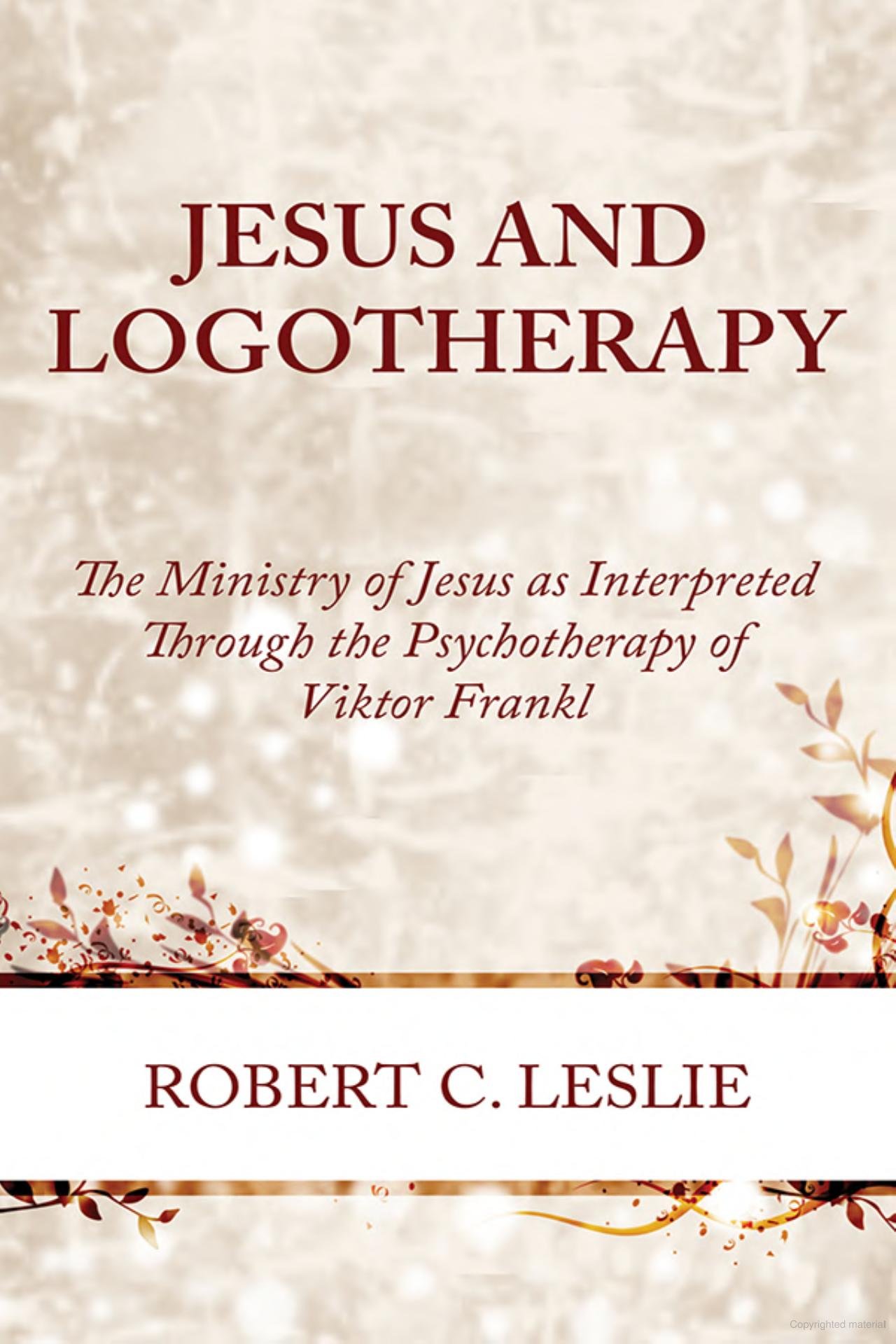
ISBN: 9781666783322
Pub Date: June 2023
Format: Paperback
Imprint: Wipf and Stock
Wipf and Stock are to be thanked for seeing to it that this long out of print book sees new life. Originally published in 1965, Jesus and Logotherapy: The Ministry of Jesus as Interpreted Through the Psychotherapy of Viktor Frankl is a thematic treatment of events in the ministry of Jesus interpreted through the lens of Viktor Frankl’s Logotherapy and Existential Analysis (LTEA, for short). Leslie was a Methodist minister, a military chaplain, and had the opportunity to study in Vienna with Viktor Frankl from 1960-1961. Published four years later, no doubt this book is the fruit of Leslie’s encounter with Frankl’s thought and its subsequent implementation in his work.
This book raises several questions, of course. First, is it a validation of the ministry of Jesus via Logotherapy, or is it a validation of Logotherapy via the ministry of Jesus? Second, do the New Testament accounts of Jesus’s ministry—including healings—count as empirical data or simply anecdotal illustrations? And third, does it count as biblical scholarship, psychological scholarship, or a type of Logotherapy as hermeneutic? Don’t get me wrong, it is inspirational reading; I think it’s great and should be read, but what is its value, especially if it is not likely to be read outside of a Christian audience?
In the preface, Leslie states that he employed the case study approach of the social sciences in his treatment of the ministry of Jesus. The goal was to apply the principles of Viktor Frankl’s Logotherapy to throw new light on the personal relationships that, as he writes, gets overlooked in biblical scholarship. He argued that the ministry of Jesus was more concerned with life transformation and helping people relate to God rather than therapy. On the other hand, he believed that the examples presented would demonstrate that modern psychology—especially Logotherapy—verifies Jesus’s methodology.
Though these assertions make me uncomfortable, I still highly recommend this book, though we must keep a few things in mind when reading it. To begin, it was the first of its kind, and it is a good reading of the New Testament along with Logotherapy. Second, it was written in 1965, and not 2023 when its premises seem too simplistic in terms of social scientific and theological practice. Even so, the book is still meaningful and valuable for different reasons.
First, most seminarians come to a class with one question for the professor, “will it preach?” This book preaches. Why? Because second, the worldview and anthropology of Logotherapy is compatible with a biblical worldview. The keyword is compatible, because one does not have to be a Jew, a Christian, or even a theist to practice Logotherapy. Frankl asserted, against Freud and others, that humans are made up of more than just drives and instincts, that humans are, in fact, beings with three dimensions: body (soma), mind (psyche), and spirit (nous). Though Jewish and religious, Frankl kept most of his writing at this human level. Thus, he used the Greek word nous to keep his spiritual therapy non-dogmatic, since in English, the word “spirit” tends to have religious connotations as opposed to Geist and Seele in German. On the other hand, Frankl welcomed the exploration of Logotherapy in a broad array of applications, including religious ones such as this book.
A third reason is many of Leslie’s readings ring true. I have to admit my skepticism about his premise gave way to wonder when I read chapter 5, “Resolving Value Conflicts,” which is about the paralyzed youth in Mark 2, to whom Jesus said, “Your sins are forgiven.” His assertion that the youth experienced physical paralysis due to extreme guilt seemed a bit far-fetched to me until I saw how he explained it. Leslie didn’t use the term conversion disorder, but that is what his premise entails. And since Logotherapy and Existential analysis is a first order therapy for noögenic (spiritual) neuroses, including physical symptoms that have a spiritual cause, I could see how Leslie’s reading of Jesus’s ministry with Logotherapy was both valid and exciting!
Here is a full listing of the readings in the book:
Exploring height psychology: the temptations of Jesus: Lk 4:1-13
Mobilizing the defiant power of the human spirit: Zacchaeus: Lk 19:1-10
Finding the personal life task: the rich young ruler: Mk 10:17-22
Filling the existential vacuum: the Samaritan woman: Jn 4:4-27
Resolving value conflicts: the paralyzed youth: Mk 2:2-12
Actualizing the self in responsible commitment: Simon the Pharisee: Lk 7:36-50
Realizing creative values: Peter: Mt 16:13-19; Lk 22:31-34, 54-62
Realizing experiential values: Mary & Martha: Lk 10:38-42
Realizing attitudinal values: the Bethesda invalid: Jn 5:2-15
Restoring man's dignity: the Gerasene demoniac: Mk 5:1-20
Exercising man's freedom: Jesus as servant: Jn 13:3-5, 12-16
My fourth reason: as I stated above, this book is actually—or simply—a Logotherapeutic reading of the ministry of Jesus. It is not an interpretation that employs a Logotherapeutic hermeneutic (as is Marshall H. Lewis’s Viktor Frankl and the Book of Job: A Search for Meaning); it is not a critique of Logotherapy for use in Christian counseling (as is Donald F. Tweedie’s Logotherapy and the Christian Faith: An Evaluation of Frankl's Existential Approach to Psychotherapy); and neither is it a Christian guide to Logotherapy (as I would describe Aaron J. Ungersma’s The Search for Meaning: A New Approach in Psychotherapy and Practical Psychology). No, it is a reading of events in the ministry of Jesus—mostly healings—along with Logotherapy, which is defined as “healing through meaning.” And can we overlook the simple fact that the root word for Logotherapy is the Greek word logos, which is also applied to Jesus in John’s Gospel?
Finally, I’m a preacher. I have drawn inspiration from this book for my own preaching and it has made a huge impact. Many people have loved and cherished this book for a long time. And as my beloved teacher, Dr. Ann V. Graber said when I told her about this book being reprinted, “Well, it’s about time!” Indeed, it is.
Tom Edmondson for meaninginministry.com
Date Of Review: September 2023
LOGOTHERAPY, THEOLOGY, AND PASTORAL PSYCHOLOGY.
By Prof. Dr. Heye Heyen
Available in German here.
Translated by Tom Edmondson for Meaning in Ministry: Pastoral Care with Logotherapy (blogsite).
On the death of Viktor E. Frankl:
On September 2, 1997, the Viennese professor of neurology and psychiatry, Viktor E. Frankl, the founder of Logotherapy and Existential Analysis, died at the age of 92. Who was this man whose work received less attention in the German-speaking world than in America, and from whose books Protestant theologians quote less frequently than their Catholic colleagues?
1. The Life of Viktor Frankl
Born in 1905 to Jewish parents in Vienna, the stronghold of psychotherapy at that time, he already corresponded with S. Freud as a high school student, from whom he turned away during his medical studies in order to join A. Adler's individual psychology. After a few years, however, there was a break here too. In 1927, Frankl, whose understanding of neuroses increasingly differed from Adler's, was expelled from the Viennese Association for Individual Psychology. From 1930 Frankl worked as a doctor at the neuropsychiatric clinic of the University of Vienna. At the same time, he set up counseling centers for young people who were in emotional distress – in no small part due to the mass unemployment of those years. Against the background of this work, Frankl developed the basic ideas of his logotherapy during the 1930s. He often recognizes a deficit in the experience of meaning or what he calls an 'existential vacuum' as the reason or breeding ground for mental suffering. Accordingly, he sees the therapeutic task as helping to find a perspective of meaning.
Frankl spent the years 1942-45 as a prisoner in four concentration camps. He later described these years as the "crucible" of his logotherapy: "Indeed, the lesson of Auschwitz was that man is a meaning-oriented being. [...] The message of Auschwitz was: Man can only survive if he lives for
something. And it seems to me that this applies not only to the survival of the individual, but also to the survival of mankind.” After the liberation in 1945 - he had lost his entire family except for one sister - he returned to Vienna. He dictated the book that would become a bestseller: Saying Yes to Life Anyway. A Psychologist Experiences the Concentration Camp. The title of the English translation is: Yes to Life in Spite of Everything. A series of scientific books followed, including his habilitation. Apart from longer
stays in the USA, where he held several guest professorships, Frankl stayed in Vienna until the end of his life.
2. Basic Ideas of Logotherapy
Frankl differs from Freud and Adler above all in that he sees the basic 'Mover' of man not in the will to pleasure or in the will to power, but in the will to meaning. If this becomes frustrated, an 'existential vacuum' is created in which all sorts of mental disorders can then proliferate and the will to pleasure or power can become dominant.
If the frustration of the striving for meaning is the main cause of a disorder, Frankl speaks of 'noögenic neurosis' and understands logotherapy as a specific therapy. According to Frankl, logotherapy is non- specific therapy for psychogenic neuroses. The anthropological place of the striving for meaning is the spiritual dimension. With the 'spirit' man is given the ability for 'self-transcendence' and 'self-distancing'. Frankl illustrates what is meant by the term 'self-transcendence' using the paradox of the eye, which fulfills its meaning and realizes itself precisely by overlooking itself and instead perceiving the 'world'. Thus, according to Frankl, man finds himself precisely by directing his attention away from himself (even more so: from his symptom) to something that is not himself: to a beloved you, to a task, to something that is worth being perceived. The therapeutic method that aims at this is 'dereflection'. Man's possibility of 'self-distancing' is shown in an ability that no animal possesses: to laugh. Humor is used above all in the probably best-known method that Frankl developed: paradoxical intention. It comes into effect wherever anticipatory anxiety produces or at least intensifies a symptom. For example, someone who, in humorous exaggeration, almost wishes to 'sweat something out for the boss like he has never seen it before' will take the wind out of the sails of his fear of expectation and possibly experience for the first time with amazement that his hands are completely dry in the dreaded encounter.
For Frankl, the spiritual dimension—here the influence of his philosophical teacher M. Scheler becomes apparent - is the basis of man's freedom to rise above his psychophysical conditionality and to take a stand and behave in relation to it. As the opposite pole of freedom Frankl sees the responsibility of man, whereby he also clearly has in mind the aspect of being responsible before whom or what.’ Unconscious spirituality is the subject of dream analysis, which, however, has a much lower significance in Frankl's practice than Freud's. His work The Unconscious God4 deals with this topic above all. The title is misleading, however, insofar as the idea that God himself can be found in the unconscious, as it were, is far from Frankl. Rather, he is concerned with making people aware of a Translator’s note: The English version is Utled, Man’s Search for Ultimate Meaning, and contains additonal material potentially repressed or undeveloped relationship with God. The spiritual dimension is also the basis of conscience, which is therefore 'ontically irreducible'. It is understood as a 'sense-probe' and is thus to be fundamentally distinguished from the Freudian superego, which Frankl does not question as such.
3. Logotherapy in German Speaking Areas
Although overshadowed by the major therapeutic schools, logotherapy has been growing in the German-speaking world since about 1980. Two 'pioneers' of logotherapy will be briefly introduced here, whose differences at the same time indicate the factual 'range' of possible logotherapeutic standpoints: the psychologist Elisabeth Lukas, director of the South German Institute for Logotherapy in Munich, and the Protestant theologian Uwe Böschemeyer, director of the Hamburg Institute for Existential Analysis and Logotherapy. E. Lukas is best known for her numerous (pocket) books in the Herder publishing house. In easy-to- understand and yet precise language, she presents the basic ideas of a (type of) logotherapy that could be described as 'orthodox'. In ever new variations, she presents Frankl's concepts, justifies them, and emphasizes their significance compared to all other currents of thought at the time (not only in psychology). In accordance with her strong emphasis on the spiritual dimension, she sees a great danger in overemphasizing the role of the psychic; according to her strong orientation to Frankl's parable of the paradox of the eye, she sees a great danger in any form of psychotherapeutic 'navel gazing'. Above all, she takes a decidedly critical stance towards depth psychology—sometimes not without polemics.
U. Böschemeyer, author of the dissertation "Die Sinnfrage in Psychotherapie und Theologie" (The Question of Meaning in Psychotherapy and Theology) published in 1976, already in the early days of his logotherapeutic activity advocated the concept of (what was then called) "integrative logotherapy". Its characteristic was a greater openness towards other schools and methods; this was especially true towards depth psychology. In the meantime, U. Böschemeyer has decisively developed logotherapy into a "value-oriented existential analysis" in his institute. The most important difference to classical logotherapy lies in the understanding and in the weighting of the unconscious, as the center of which the spirit and thus the orientation towards values is seen. Through the method of 'value-oriented imagination' developed by Böschemeyer, values such as 'self-acceptance' can be experienced via inner images and, if necessary, their obstacles can be recognized and worked on. In recent years U. Böschemeyer has become known to a wide audience through several books and numerous small publications (SKV Edition).
4. Logotherapy as an Object of Theological and Pastoral Psychological Interest The interest shown by theologians in logotherapy or in the work of V.E. Frankl is - especially on the Protestant side - on the whole rather low. For example, it must be noticed that H. Gollwitzer in his two monographs on the question of meaning does not explicitly refer to Frankl in a single place. Two theological dissertations take a look at Frankl's anthropology: the work of U. Böschemeyer (supervised by H. Thielicke) from a systematic-theological point of view, and the work of St. Peeck from a practical-theological point of view (significance for suicidal people). Wolfram Kurz, professor of religious education and at the same time director of an institute for logotherapy and existential analysis in Tübingen, makes logotherapy fruitful for religious education in several publications, including his dissertation and his habilitation thesis. Among the German-speaking authors, he is probably the one in whom logotherapeutic and theological or religious pedagogical elements interpenetrate most strongly and result in an overall conception.
In his (practical-theological) dissertation, Karl-Heinz Röhlin compares existential analysis and logotherapy with the more recent Protestant concepts of pastoral care. From logotherapy he gains impulses for a 'meaning-oriented pastoral care', which he understands - in modification of the well- known thesis of D. Stollberg - as "logotherapy in the church context."5 Nevertheless, the well-known representatives of Protestant poimenics as well as pastoral psychology on the whole only make very peripheral reference to Frankl and his school(s), if at all. Incidentally, the reverse is even more true: Frankl himself and authors who define themselves primarily as logotherapists hardly take any notice of pastoral psychology or clinical pastoral training.
5. Opportunities for Dialogue
Since I myself have completed both the Clinical Pastoral Education (CPE) and various pastoral psychological training courses on the one hand, and an existential-analytical-logotherapeutic training (with U. Böschemeyer) on the other hand a good ten years ago, I have been interested in integrating some methods that I owe to pastoral psychology within the training of logotherapists and the CPE. Conversely, I would like to see logotherapeutic insights included in the training of pastoral workers and pastoral psychologists.
I can only indicate here in the form of theses what the main benefits for both sides could be.
a) The benefit for (prospective) logotherapists from contact with (representatives of) protestant poimenics and pastoral psychology could be the following:
- Sensitization to the fundamental desire to be accepted – for this, the central consideration of the 'will to meaning' must not obscure the view;
- Overcoming an anthropological reductionism that actually largely understands fear only in terms of the paradigm of 'anticipatory fear' and does not take it into account as existential;
- Striving for an attitude that tolerates open questions and is skeptical of hasty answers;
- Raising awareness of the danger of dealing with oneself and others in a moralizing manner;
- Discovering a human 'right to complain' (up to and including accusing God; see Psalms);
- Sensitization to the fact that faith is also only lived in this world and that therefore ecclesiogenic damage (and analogously: comparable dangers through neologistic counseling) must also be taken into account.
b) The benefit for (prospective) ministers and pastoral psychologists from contact with (representatives of) logotherapy and existential analysis could be the following:
- Sensitization for the perception of the pastor and client under the aspect: "What are his 'pillars of meaning'? (A parameter for assessing suicidality or resilience!);
- Self-awareness also under the aspect: 'Me and my values';
- Working with dreams and the imagination under the perceptual attitude: unconscious belief, unconscious hope, unconscious love;
- Sensitization to the mechanism of 'hyper-reflection' (Frankl) of one's own problems and their reinforcement that occurs as a result;
- Becoming familiar with the methodical handling of dereflection;
- Recognizing and avoiding any personal psychologistical tendencies; Frankl concludes:
“Sigmund Freud taught us the importance of debunking. But I think it has to stop somewhere, and that's where the 'exposing psychologist' is confronted with something that just can't be exposed anymore, for the simple reason that it's real. The psychologist, however, who cannot stop exposing there either, only exposes the unconscious tendency to devalue what is genuine in people, what is human in people.”
LITERATUR:
U. Böschemeyer, Die Sinnfrage in Psychotherapie und Theologie. Die Existenzanalyse und
Logotherapie Viktor E. Frankls aus theologischer Sicht, Berlin / New York 1976; ders., Logotherapie
und Religion, in: G. Condrau (Hg), Die Psychologie des 20. Jahrhunderts, Bd. 15, Zürich 1979, 296-302;
ders., Neu beginnen! – Konkrete Hilfen in Wende- und Krisenzeiten, Lahr 1966; J.B. Fabry, Das Ringen
um Sinn. Eine Einführung in die Logotherapie, Freiburg 1980 [2]; V.E. Frankl, Theorie und Therapie der
Neurosen, München / Basel 1975 [4]; ders., ... trotzdem Ja zum Leben sagen. Ein Psychologe erlebt
das Konzentrationslager, München 1978 [2]; ders., Ärztliche Seelsorge. Grundlagen der Logotherapie
und Existenzanalyse, Wien 1979 [9]; ders., Der unbewußte Gott. Psychotherapie und Religion,
München 1979 [6]; ders., Das Leiden am sinnlosen Leben. Psychotherapie für heute, Freiburg i.Br. /
Basel / Wien 1981 [6]; ders., Das Leiden am sinnlosen Leben. Psychotherapie für heute, Freiburg i.Br. /
Basel / Wien 1981 [6]; ders., Der Wille zum Sinn. Ausgewählte Vorträge über Logotherapie, Bern /
Stuttgart / Wien 1982 [3]; ders., Der Mensch vor der Frage nach dem Sinn, München 1985 [4]; ders.,
Was nicht in meinen Büchern steht: Lebenserinnerungen, München 1995; H. Gollwitzer, Krummes
Holz – aufrechter Gang. Zur Frage nach dem Sinn des Lebens, München 1970; ders., Ich frage nach
dem Sinn des Lebens, München 1974; W. Kurz, Ethische Erziehung als religionspädagogische Aufgabe.
Historische und systematische Zusammenhänge unter besonderer Berücksichtigung der Sinn-
Kategorie und der Logotherapie V.E. Frankls, Tübingen 1983; ders., Seel-Sorge als Sinn-Sorge: Zur
Analogie von kirchlicher Seelsorge und Logotherapie, in: WzM 37 (1985), 225-237; ders./ F. Sedlak
6 Frankl 1995, 104.
6
(Hg.), Kompendium der Logotherapie und Existenzanalyse. Bewährte Grundlagen, neue Perspektiven,
Tübingen 1995; E. Lukas, Von der Tiefen- zur Höhenpsychologie. Logotherapie in der Beratungspraxis,
Freiburg i.Br. 1983; dies., Auch dein Leben hat Sinn. Logotherapeutische Wege zur Gesundung,
Freiburg i.Br. 1984 [2]; dies., Von der Trotzmacht des Geistes. Menschenbild und Methoden der
Logotherapie, Freiburg i.Br. 1986; dies., Lebensbesinnung. Wie Logotherapie heilt. Die wesentlichen
Texte aus dem Gesamtwerk, Freiburg i.Br. 1995; M. Nicol, Die Religion in Existenzanalyse und
Logotherapie nach Viktor E. Frankl, in: WzM 38 (1986), 207-222; St. Peeck, Suizid und Seelsorge. Die
Bedeutung der anthropologischen Ansätze V.E. Frankls und P. Tillichs für Theorie und Praxis der
Seelsorge an suizidgefährdeten Menschen, Stuttgart 1991; K.-H. Röhlin, Sinnorientierte Seelsorge. Die
Existenzanalyse und Logotherapie V.E. Frankls im Vergleich mit den neueren evangelischen
Seelsorgekonzeptionen und als Impuls für die kirchliche Seelsorge, München 1988.
The Place of Acceptance
By Prof. Dr. Heye Heyen
Available in German here.
Translated by Tom Edmondson for Meaning in Ministry: Pastoral Care with Logotherapy (blogsite).
The Place of Acceptance
Starting Point
"What conditions and possibly practical elaborations serve the goal of people becoming familiar with experiences of transcendence and the depth of existence, of people being encouraged to believe in God's kingdom, of people feeling at home in rites, symbols, and what is peculiar to the language of faith...?"
These questions have been formulated by Evert Jonker (1996,6) with regard to catechetical accompaniment especially of groups. In this article I take these questions as a starting point for some theological reflections on pastoral accompaniment of (especially) individuals. In doing so, I limit myself, in terms of content, to a central theme of the language of faith, namely, the doctrine of justification by faith alone, without works of the law. I pose the question of what experiences people can have in which they can access what is meant by the word "justification." In particular, I will examine what the "value-oriented imagination" according to U. Böschemeyer can contribute to this. Of these, I will describe and briefly discuss three examples from my own psychotherapeutic practice. Then I will address the question of the "truth content" of the symbols from the imaginations. Further, I will address the question to what extent the search for an inner experience can do justice to the message of justification as a "verbum externum".
JUSTIFICATION AND ACCEPTANCE
In the language of faith, the doctrine of justification by faith alone, without works of the law, occupies a central place in the evangelical (particularly the Lutheran) tradition. This doctrine is seen as the "articulus stantis et cadentis ecclesiae": where this article is taught (and learned), there is church. According to Lutheran orthodoxy, there can be no question of church where this does not happen (Köhler, 329). Of course, from an empirical point of view, it cannot be denied that the term “justification” with its theological charge is no longer understood even by many regular churchgoers. At this point, even for them, the traditional language of faith has become a foreign language. That is the reason why Paul Tillich in particular, as a systematic theologian, felt called upon to plead for a translation. He suggested replacing the term "justification" with the term "acceptance":
Since "justification" is a biblical expression, it cannot be avoided in the Christian churches today either. But in the practice of teaching and preaching, it should be replaced by the word "acceptance." Acceptance means we are accepted by God even though we are unacceptable according to the criteria of the law (the law contrasts our essential being against our existential alienation). We are asked to accept that we are accepted. (1966, 258)
A practical-theological translation relates less to thinking and to the problems that thinking may have with the doctrine of justification than a systematic-theological one. The practical theologian is more interested in the experiences people have with 'acceptance' these days: where, when and by whom do they feel comfortable or not accepted? What are the conditions under which they may or may not accept being accepted? This is the empirical "pole" of (bipolar) practical theology. In this case, the other "pole" asks about the purpose of biblical and dogmatic statements about "justification" and about a theologically responsible translation. The practical theologian brings these two "poles" together in a (mutually constructive-critical) conversation.
The pastoral care movement has adopted Tillich's proposal. It is no coincidence that in the German-speaking area the usual term for what is mostly called "therapeutic pastoral care" in the Netherlands is referred to as "Acceptance-Giving Pastoral Care" (Annehmende Seelsorge). Everything revolves around "acceptance." "Perceiving and Accepting" is the programmatic title of a well-known book by Dietrich Stollberg (1978). "Acceptance-Giving Pastoral Care" (Annehmende Seelsorge) is designed so that in contact with the pastor, the interlocutor can have the experience: I am accepted—by the pastor and (even if this is perhaps not explicitly stated), by him in whose name the pastor listens to me and speaks to me.
Theological criticism of the use of the term "acceptance" as a synonym for "justification" in accepting pastoral care was brought forward above all by Helmut Tacke (1979, 127-146). He sees this as a misuse of the "pro me” since the explicit Christological underpinning and thus the anchoring in the "extra nos" is missing. However, the question is whether it is theologically legitimate to see Christ's presence so dependent on the question of whether he is explicitly mentioned by name. Can't the justifying Christ come in the form of the accepting neighbor (here: the pastor) just as well as in the “least brother” of Matthew 25? And as for the distinction between the "extra nos" and the "in nobis": secundum rationem essendi it is undoubtedly necessary to posit this difference. But secundum rationem cognoscendi (or experiendi) what is primary is the experience: “I am accepted”. In contrast, identifying the subject (“who is the one who accepts me?”) is secondary. If you only look at the feelings triggered, the difference between an acceptance by myself or by another person or by God is not a principle one.
EXPERIENCING ACCEPTANCE
Where and how can acceptance become tangible? In accepting pastoral care, this is answered: by way of contact with the accepting pastor.
As a complement, in this article I will present an approach to the experience of acceptance that has been developed over the last 15 years, albeit outside the discourse of pastoral practitioners. These are the “value-oriented imaginations” developed by the theologian, psychotherapist and logotherapist Uwe Böschemeyer (1996, 2005, 2007). By this he understands a kind of active dream travel, preferably to certain "places" in the unconscious "world" that symbolize certain values such as "the place of love" or "the place of healing".
When I was working as a therapist myself, I worked with this method several times. With some clients who had a hard time accepting themselves or believing that someone else could accept them, I have taken the "Journey" to the "Place of Acceptance". In the following, I will describe three examples of these “journeys” and briefly discuss each one.
Ms. D
Ms. D. was a 27-year-old law student. She felt insecure in many ways, found it difficult to say “no,” and sometimes hurt herself. On the occasion of a dream, she said she still blamed herself for a number of small things. For example, as a child she had once locked up the neighbor's girl for a few minutes and once ate another child's ice cream.
Because I had the impression that there was a clear lack of (self-) acceptance in her life, I suggested to her in the 5th session an imaginary journey to the "place of being accepted". I had deliberately chosen this abstract formulation because it leaves open (leaves it to her unconscious, as it were) who or what the accepting subject is. This could be other people (or also an animal), this could be herself, this could also be "life" or God.
She leans back relaxed, closes her eyes and waits a moment for possible images.
Her journey begins in a small grotto, from where a kind of serpentine path leads down. It feels good to go down here on the dry clay ground. After opening a heavy wooden door, she enters a beautiful mountain landscape, walks past grazing cows, with whom she carefully makes contact, until she comes to some houses. She would like to knock there, but she doesn't want to be intrusive and moves on. Finally she comes to a (Mediterranean) marketplace with a large fountain. People sit there, eat and drink. There is a happy atmosphere, someone is playing the guitar. A woman comes up to them and invites them in, people move up and there is room for them. There is also a very old woman with wrinkles who radiates a lot of warmth. There is also a little (sympathetic) boy there, he is a bit dirty and has a snotty nose. She cannot understand the words of the language spoken there, but she can understand the meaning.
After a while I propose to say goodbye (she would have preferred to stay there for a long, long time...) She hugs both women warmly.
A climax can be observed in these images that I have often encountered in such imaginations: a) the person is alone in a beautiful natural landscape, there is a lot of space, there is nothing that would be threatening; b) She encounters (friendly) animals with whom she makes contact; c) There is contact with people.
Ms. D. would have preferred to sit with the people on the market square for hours – here she obviously sensed an atmosphere of acceptance that she missed in her conscious life. A good example of this is the little boy who – albeit dirty and with a snotty nose – is allowed to be there and who also has her sympathy. Even as a child, she was probably admonished or rejected if she looked like that. And surely, even in her conscious life, she could hardly ever allow herself to resemble this boy.
I said to her: You can always come back to this marketplace. She did this several more times in the weeks that followed, each time having a beneficial experience of (self) acceptance.
Ms. U
Ms. U. was a 45-year-old biologist and came to therapy because she felt empty and thought she had too little "basic trust". She had various psychosomatic symptoms. Her father died suddenly when she was eleven. After that, her mother started drinking. Religion had never played a special role in her life. After a while, I also go on a “journey” with her to the “place of acceptance”.
Her journey begins (ground floor) at a wooden door that she cannot open. She walks a long way along a wall until she discovers a shaft with a staircase. She descends and enters a domed hall. The room is open at the top, there are high walls on the sides, the ground is dry; except for a blade of grass, there is nothing living there. She goes back upstairs and continues walking along the wall. Suddenly the path becomes a tunnel leading to a (Catholic) church. There are stained windows and lots of gold. She walks around. Suddenly, she meets a monk in a black robe and with a long white beard. He is very friendly and says he was expecting her. He invites her to come with him to the sacristy (crypt). There are two chairs and a table. He pours tea and listens to her. She can tell whatever is on her mind and can come back at any time. When he says goodbye, he hugs her.
When Ms. U. opened her eyes again, she was very touched by what she had just experienced. It felt like she had finally found what she had been looking for. Especially meeting the old monk had done her a lot of good and fulfilled a deep longing. It was an experience of acceptance, in her case acceptance in the name of (or even by) the god who had never played a special role in her conscious life.
It was certainly no coincidence that her “journey” first took her to two “places” where this experience of acceptance was not possible. The first place is not in the depths, but "par terre" (on the ground), in their conscious world. It could be that in principle the experience would be possible there, but it fails to open the "door" (access to it). The second place is probably "lower down", maybe the dome even makes you think of a former church building, but it is empty, there is (almost) no life there. And she knows intuitively: I have to keep looking - until she finds what she is looking for in that Catholic church.
Ms. M
Ms. M. was a single 35-year-old nurse. She was lonely, never had a boyfriend. She was, in her own words, depressed and often felt guilty. For reasons that could no longer be clarified, her mother had rejected her as a child and humiliated her in an inhuman way. From the fourth session on I went on some imaginary journeys with her. My goal was "the place where I can be myself". She sat back, closed her eyes, and opened for pictures from within.
In the beginning she is at her parents' house, but there she can't find anywhere to descend. Then she goes into a forest. There she finds a hollow about two meters deep. She climbs in and gets into a very long horizontal corridor. After a while she sees a door. She knocks, but no one calls her in. Finally she opens the door herself and sees that there is a grotto behind it. She goes in without being asked. There she sees a woman of about 30 who looks like the Madonna. She stands there very unperturbed and (almost) doesn't react to her. Maybe the Madonna is a bit awkward.
She goes on. She crawls through a long underground passage until it suddenly becomes very bright (almost blinding). She is in a forest; she walks a little there and comes to a clearing. After lying there in the grass for a while, she moves on. A roe deer comes to her, she strokes it. Hares and stags also come, they are all very tame and know her. She strokes them and moves on. To the left of the path the forest is (scary) dark, to the right the flowers and shrubs are in full bloom. She takes a red flower with her. But she knows: "If I want to reach my goal, I have to go into the dark forest."
I suggest you do that next time. She says goodbye and returns. She opened her eyes and said, visibly touched: That was beautiful! She had had experiences (feelings, desires, dreams) for which there was little room in her conscious life. It was crucial for the therapy that she could experience and feel this unconscious world, not that it was analyzed cognitively.
For the sake of the reader, I give a short analytical comment below.
Ms. M.'s search for the “place where I can be myself” begins – certainly not by chance – at her parents' house. This is the place where, if all is well, the child has the first fundamental experience: "I am allowed to be, I am welcome, I am accepted." But in her case, "all was not well,” especially as her mother had repeatedly shown her rejection in a very hurtful way. She will not be able to find access to the experience of being accepted by her parents, which means looking in the wrong place.
Just as Hansel and Gretel's path in the fairy tale leads out of their parents' house (with their mother who rejects them) and into the forest (often a symbol of the unconscious), Ms. M. also continues her search in the forest. There she will probably find a descent, although it doesn't really lead into the depths. A long horizontal corridor leads you to the Grotto of the Madonna. (Ms. M. was brought up a Catholic.) What could be more obvious for a child who has been rejected by its own mother than to seek consolation and protection from the “Mother of God”, from “Mother Church” or even from a “maternal” side of God. But no one calls her in there, no one welcomes her there. The Mother of God is just as unmoved as her own mother once was. Even if Ms. M. tries to excuse that a little (probably in the same way as her own mother: "Perhaps she is a bit clumsy"), she nevertheless recognizes, “I'm looking in the wrong place here too.”
If the place of acceptance cannot be found either with her parents or in the faith she learned there, she will have to look for it in an as yet unknown, “completely different” “world”. There is a long dark underground passage that leads there, reminiscent of the tunnel that people describe after a near-death experience. It gets very light at the end of this corridor. It seems to be a place where she feels safe and glad to be there. She lies down on the grass and her whole body is in contact with the ground (that carries her). The animals are tame, they know her and let her pet them. Ms. M., who – based on her experience, very understandably – has always been afraid of contact with people and who has therefore become very shy herself, now experiences very pleasant contact with animals that are normally known to be shy. The shy animals make the shy Ms. M. feel understood and accepted - and she herself shows affectionate feelings towards the shy animals by petting them. (Interpreted at the “subject level,” this could mean that she is no longer fighting off her own shy parts but is lovingly in touch with them and is “at peace” with them.)
I want to tell you that in later imaginative session these animals were there every time and accompanied her (so she dares to go into the dark forest) and that the loving contact between her and the stag continues to develop: the stag lays his head on her shoulder, and she does the same to him. She emphasizes that this is "not really erotic". (But it is certainly a fearless and therefore very important preliminary stage.) The blooming bushes and especially the “red flower” (rose?) that she takes with her may well be understood as an indication that in this “world” there is also room for her longing for love. But before that longing can be fulfilled, she will have to face the frightening things that still lie hidden in the dark forest.
After that happened (especially the encounter with her dead but not yet really buried mother), we went on the last journey of imagination about eight weeks later:
The stag and the rabbit are already waiting for her. The stag wants to walk along the forest with her, but he doesn't want to go into the forest. She takes the hare on her shoulder and walks alone (with him, without the stag) into the dark forest. After walking for a while and taking a rest, she sees a bright glow in the distance. As she gets closer, she sees an angel standing there. At first she doesn't want to go there. He has spread his arms. So much kindness feels suspicious to her. But eventually she goes to him. He keeps getting bigger and she keeps getting smaller. He takes her in his arms and rocks her back and forth like a small child, after which she is allowed to sit on his knee. Finally he takes her by the hand and walks with her to the place where she says goodbye to him and to the hare and the stag.
Of course, after this final imagination, Ms. M. herself was most impressed by her experience on the angel's arm and lap. What she had painfully had to do without as a child from her mother, she had now received from the angel.
EXPERIENCING TRANSCENDENCE?
I have recounted three experiences of (dream-like images of) the place of acceptance, two of which contain overtly religious symbolism. For these three women, the subject of the acceptance they long for and feel during imagery is not themselves. What they experience during imagery is, to them, not an experience of self-acceptance but of being accepted through other people (Ms. D.), be it through animals (Ms. M.), be it through God or in his name (Ms. U, Ms. M.).
The latter in particular will trigger the following two questions, among others, in a theological discourse. The first question is: Is this about fiction or about reality? Is not the acceptance by God or in his name, which is experienced during an imagination, exclusively the projection of a self-acceptance? That would mean somebody accepts himself and projects the subject of this acceptance on an old Italian woman, on a hare or a stag, on a monk or an angel. Is there then a difference in principle between the angel and the stag? Is the angel (or his attention) an external reality in a different way than the stag (or his attention)? And if this is not the case, then what is the use of such an imaginative experience?
When Frankl (1979) speaks of the “unconscious God”, he does not mean that God himself can be found in the depths of the human soul, so to speak. What can be found within the human soul is at most an (unconscious) longing for God or an (unconscious) trust in God. To use the words of Acts 17, perhaps deep within man has an altar to the unknown God, but of course not (an "empirical" approach to) God Himself.
Anyone who calls Ms. M.'s experience of the angel's arm "fiction and not reality" does justice to the fact that the thesis that she was "really" in contact with the angel and with the stag only "in her imagination," is absolutely untenable. In this respect there is no fundamental difference between the stag and the angel. Anyone who speaks here of "fiction as opposed to reality" also does justice to the theological rejection of a supernaturalism that ultimately does not see God “vis-à-vis” the world, but as a factor among other factors in the world (Tillich 1973, 11-16). But it does not do justice to the fact that in the subjective perspective there is not only the alternative "fiction or reality" but also an intermediate space, which Winnicott (1971) has described as a "transitional space". Or in the terms of A. Lorenzer (1970): Anyone who considers Ms. M.'s imagination of the angel to be legitimate only when it is a matter of contact with an external reality does not understand the angel (or the stag) as a symbol, but as a cliché. In the words of Tillich (1961, 53-57), then, we are talking about a “literalistic misunderstanding” of the symbol. It may very well make sense to relate to a symbol, knowing that it is a symbol. Tillich (ibid.) then speaks of a "broken" symbol. But to what extent can one then speak of “truth”?
In the imagination, Ms. M. sees and experiences herself as someone who "may be" and who is worth being accepted: not only by individuals who may like her, but in a deeper, "ultimate" and "unconditional" sense. She imagines and feels an acceptance that transcends her actual biographical experiences. The angel is thus a symbol for a transcendent reason for acceptance. She assumes so. This is - epistemologically seen—a postulate (of practical reason, to speak with Kant), even if the postulating instance here cannot be "filled" by pure ratio, but rather by the "heart," according to the dictum of Pascal: "Le cœur a ses raisons, que la raison ne connaît point."
This makes the second question all the more urgent: How does such a "postulate of the heart" (and its tangibility) relate to the verbum externum?
Seen theologically, isn't justification something that is proclaimed to man from outside and that he then accepts (and only then perhaps also feels and translates into images)? And does not justification mean that the proclaimed Word adds something to the being of man by making him righteous before God? What else does the proclamation add besides a new label, if acceptance by God can also be experienced independently of the proclamation by means of an imagination?
Here we are dealing with a tension between a piece of traditional religious truth and a piece of empirical reality. It cannot be the task of the practical theologian to resolve this tension by means of a systematic theological answer (following K. Rahner, for example). Rather, it is the task of the (bipolar) practical theologian to endure the tension and bring both sides into a (mutually constructive-critical) dialogue. In this case, this can mean: Based on the piece of empirical reality, the representative of the truth of faith is asked the critical question of whether he sufficiently considers the following two points:
It can only be said that a person is struck by the message of justification when he feels accepted.
A message that also wants to touch a person's feelings does not come into a vacuum. In fact, the message of acceptance by God ties in one way or another with the hearer's previous experience (positive or negative) of acceptance.
Based on the traditional truth of faith, the practitioner is asked the following questions:
Have people like Ms. M. and Ms. U. ever heard the message of justification in class or at church in a way that struck and touched them?
What will that look like in the future? How can the message of justification be explained and proclaimed to people like Ms. M. and Ms. U. in a way that connects to their experiences in the imaginations?
It is the task of the practical theologian not to end the dialogue between the representative of the truth of faith and the representative of empiricism/practice, but to keep it going. Of course, this is not a game to pass the time, but the specific contribution towards the goal that Evert Jonker (1996, 6) put into words as follows: “that people become familiar with experiences of transcendence and the depth of existence, that people are encouraged to believe in God's kingdom, to feel at home in rites, symbols, and that which is peculiar to the language of faith."
BIBLIOGRAPHY
Böschemeyer, U., Dein Unbewußtes weiß mehr, als du denkst. Imagination als Weg zum Sinn, Freiburg 1996.
Böschemeyer, U., Unsere Tiefe ist hell. Wertimagination – ein Schlüssel zur inneren Welt, München 2005.
Böschemeyer, U., Gottesleuchten. Begegnungen mit dem unbewussten Gott in unserer Seele, München 2007.
Frankl, V.E., Der unbewußte Gott, München 1979.
Heitink, G., “De theologie van de Klinische Pastorale Vorming of: Wybe Zijlstra als pastoraal-theoloog”, in: G. Heitink and others, Ontginningswerk. Bijdragen voor dr. Wybe Zijlstra, Kampen 1985, 112-118.
Jonker, E.R., “Thuis raken in geloof. Ten geleide”, in: Praktische theologie 23/4, 1996, 1-8.
Köhler, W., Dogmengeschichte II, Zürich 1951.
Lorenzer, A., “Symbol, Sprachverwirrung und Verstehen”, in: Psyche 12, 1970, 895 ff.
Stollberg, D., Wahrnehmen und Annehmen. Seelsorge in Theorie und Praxis, Gütersloh 1978.
Tacke, H., Glaubenshilfe als Lebenshilfe. Probleme und Chancen heutigen Seelsorge, Neukirchen 1979.
Tillich, P., Wesen und Wandel des Glaubens, Berlin 1961.
Tillich,P., Systematische Theologie Bd. III, Stuttgart 1966.
Tillich, P., Systematische Theologie Bd. II, Stuttgart 1973.
Winnicott, D.W., Playing and Reality, London 1971.
Meditation for a Balloon Release
Rev. Tom Edmondson
Subject area: Funerals, child’s funeral
I conducted a memorial service for a 12-year-old who died unexpectedly. The family wanted to do a balloon release at the conclusion of the service. They distributed helium balloons to the friends and family of the deceased, asked them to write a message on it, then release it. As I thought about what to say for this portion of the service, I was reminded of Elisabeth Lukas’s well-known “Candle Meditation.” Drawing inspiration from that, I composed the following “Balloon Meditation.”
I love the idea of a balloon release. Balloons are loved by children and adults alike. Think about how a balloon is like life.
A balloon has no life until it is filled with air. These balloons are filled with helium, but we also fill balloons with our breath. In the Bible, the Hebrew word for “breath” is also the word for “spirit.” As Genesis 2:7 says, “the Lord God formed man from the dust of the ground and breathed into his nostrils the breath of life, and the man became a living being.”
For a while, that breath—or helium—animates the balloon, but over time, the balloon loses its elasticity and the breath escapes. Some balloons stay inflated for a long time, but others only stay inflated for a short time. So it is with our earthly bodies. We are animated for a time, and then the breath—or spirit—returns to God.
Our children are like balloons. We bring them into the world, but God gives them life. And like a balloon, we cannot hold on to them, but must release them. Just as the balloons float upward towards heaven, we commend our sons and daughters to the Lord.
[Child’s name] time was too short. You will all miss him/her dearly. I hope you will find comfort in seeing the balloons rise into the sky. Remember that you have given [Child’s name] up to Heaven, and there is no better place for him/her to be.
Take a minute to remember what you love the most about [Child’s name]. On a balloon write a prayer, a favorite memory, a story, or anything else you like. When you are ready, release the balloon into the air. Every balloon represents a prayer, a beautiful message, or memory of wonderful human loved by all.
Copyright 2023 Rev. Tom Edmondson, meaninginministry.com. All rights reserved. Permission is granted to use or share this meditation with proper citation of its author and source.